

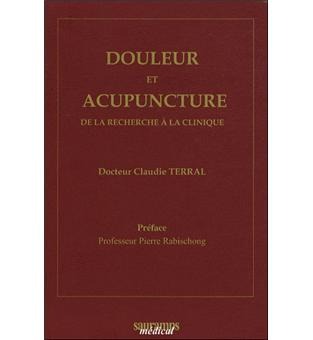
C. Terral Douleur Et Acupuncture Edit. Sauramps Medical
Claudie TERRAL, Published by SAURAMP MED. 306 pp.
This book is a personal account, the result of my work as a researcher and physician in Montpellier from 1972 to 2007, with the aim of offering a different perspective on acupuncture through observations...
Reference : 111622
37,91 € ex-tax
In detail
C. Terral Douleur Et Acupuncture Edit. Sauramps MedicalPREFACE “Disbelief is sometimes the vice of a fool, and credulity the flaw of a man of wit. The man of wit sees far into the vastness of possibilities; the fool sees little possibility beyond what already exists. Perhaps this is what makes one timid and the other reckless. ” — Denis DIDEROT (1713–1784) In an era when everything must change in light of the globalization of economic and social issues, human beings retain their distinct characteristics far beyond the boundaries they have imposed upon themselves. Pain remains for him a necessary obligation that he would like to avoid as much as possible, which justifies all therapeutic attempts—including the millennia-old practice of acupuncture introduced by the Chinese, which has endured over time, albeit with numerous efforts to better understand it and make it more scientifically acceptable. This is precisely the subject of the book presented by Dr. Claudie Terral, who practices modern and effective medicine and has devoted a great deal of time to rigorous experimental research, the key stages and indisputable results of which she details here. Admittedly, this has not been a smooth journey, as acupuncture is—and has been—considered a form of so-called “alternative” or “complementary” medicine, more or less mysterious, involving the insertion of needles into the skin at points located along lines called meridians, which bear the names of organs given to them by the Chinese. This seemingly irrational practice is based on the circulation of energy through yin and yang.
It has a long tradition and, as a result, an idiomatic language that no longer seems to us to meet the semantic demands of our century and the exponential development of the life sciences. In any case—and no one can deny this—it retains the advantage of being cost-effective against the backdrop of a crisis in which Social Security is increasingly concerned with the health of its finances.
To break free from this burdensome and outdated tradition, we have benefited from a few fortunate circumstances. My encounter in the 1960s with Jacques Niboyet—a remarkable, open-minded practitioner with immense scientific and medical knowledge—introduced me to a group of innovative physicians: Henri Jarricot, Paul Nogier, René Casez, and René Bourdiol—the founders of the GLEM (Lyon Group for Medical Studies)—who were eager to better understand what they were doing: acupuncture and spinal manipulation, which were not taught at the time in medical schools, the oldest of which was located in Montpellier. They came to visit me at the anatomy laboratory I was in charge of and agreed to work with me on cadavers to seek facts rather than merely hypotheses. I was then fortunate, in 1971—after ten years of effort—to secure the creation of INSERM Research Unit 103 (National Institute of Health and Medical Research), for which I had been able to draw up the plans to ensure that experimental programs could be carried out under optimal conditions. Jacques Niboyet had previously written a scientific thesis on the electrical properties of acupuncture points, demonstrating their lower resistance to electrical current. This observational finding clearly deserved to be substantiated and linked to the anatomical structure of the point as described by the Chinese. Although this type of research did not exactly fit within the field of biomechanical research specific to my unit, I decided to embark on it, especially since we had strong engineering capabilities that allowed us to define a rigorously scientific protocol using highly precise measurement instruments. But everyone knows that conducting research requires two essential conditions: first, in addition to ideas, one must have resources—particularly financial ones—and we had those; and second, one must have capable hands guided by a sharp mind, and we were fortunate that Claudie Terral, then a lab assistant in the Anatomy Department, agreed to oversee the protocol with the assistance of our motivated group of physicians, who were already overwhelmed by their medical practices. I therefore feel compelled to pay tribute to her for her passion for this research and for having devoted so much time to it while simultaneously pursuing graduate studies at the School of Medicine, earning certificates and a degree in human biology (DERBH). Her remarkable research work should logically have culminated in a dissertation, which she had written after years of dedicated effort. Unfortunately, this did not account for the bigotry and malice of a few pretentious and narrow-minded academics who opposed her defense. Despite the unacceptable prejudice resulting from such a practice—which demonstrates, if proof were needed, that acupuncture has not yet been fully accepted in our universities—what matters most is the final result of this research, which is presented in detail in Claudie Terral’s book.
Indeed, one cannot overemphasize the importance of this scientific approach to acupuncture, which provides indisputable foundations for this millennia-old empirical practice. First and foremost, it must be remembered that pain—so often disparaged and combated—is part of the human body’s functional program as a priority alarm signal, serving as the basis for the protection of biological structures. As soon as possible after an injury, it triggers withdrawal reflexes or flight responses that are essential for an individual’s survival. There is no such thing as unconscious pain; consequently, this signal floods the cerebral cortex after selective relay in the thalamus—which serves as the convergence center for all afferent signals from the nervous system and the mandatory transit point for numerous descending pathways. Patients who have experienced anesthesia in a specific skin area are well aware of the harm caused by burns that go unnoticed and are therefore not avoided. However, certain chronic pains have only a distant connection to the organic lesions that gave rise to them, and they become highly debilitating, constituting in some cases a genuine disease—a legitimate reason for seeking medical consultation and treatment. Gaining a thorough understanding of the pain pathways and all the neurochemical mediators involved in pain transmission was the primary objective of our research. It is obviously necessary to distinguish between pain caused by an external injury—such as a prick to a finger or a skin wound—which has a very precise, consciously perceived location, from pain of internal visceral or spinal origin, which lacks this precise organic localization precisely because the individual has poor awareness and perception of “their own biological self.” This leads us, secondly, to emphasize the fundamental role of the skin, which remains poorly understood by many. It is a sensory “garment” of remarkably intelligent design and rich innervation. It is supple and mobile, yet anchored by fibrous ligaments extending from its deep surface to the underlying structures: skeletal elements (clavicle, pelvis, spinal processes of the spine, skull, etc.), joints, aponeuroses, and tendon sheets. Its avascular superficial epidermal layer experiences continuous growth of cells that rise to the surface and die from desiccation upon exposure to air, accompanied by “unmyelinated” nerve fibers sensitive to light touch. The dermal and hypodermal layers contain a vast number of nerve receptors, most of which are encapsulated and capable of detecting specific types of sensation: touch (Pacini, Meissner, and Merkel corpuscles), stretch (Ruffini corpuscles), or temperature (Krause corpuscles). As a result, the skin serves as an extraordinary interface not only with the external environment (exteroceptive sensitivity) but also with the body’s interior (conscious proprioceptive sensitivity). This point deserves careful consideration. Humans operate a highly intelligent and complex machine with only the minimum necessary instructions. A complete novice—or even a pet—can perform complex motor tasks without needing to know that they have hundreds of muscle actuators to control; and, curiously, a person with a thorough understanding of biology does not function any better than a novice. This means that the control mechanism is simple and uses a global language based on movements rather than on muscles. But robotics has taught us that to control a body segment in three-dimensional space, the brain must know the state of the muscle motors (relaxed, contracted, or stretched) and the angles of the segments. Neuromuscular spindles, which sense stiffness, and Golgi organs, which sense force, provide information about the states of the muscles. As for segmental angles, they cannot be measured by the muscles (due to redundancy and the absence of a “brain library” of muscle insertions for possible geometric calculation) or the ligaments. The ingenuity of the machine’s designer lies in using the skin as a goniometer. Any movement whatsoever causes a deformation of the periarticular skin, which is translated into a position and movement signal by the skin’s Ruffini receptors. Any insensitive segment cannot be controlled by the motor system. There is a statokinetic loop connecting the motor cortex in area 4 of the precentral gyrus to the sensory cortex in areas 1, 2, 3, and 5 of the postcentral gyrus, which allows us to consciously and constantly know where we are and where we are going with our bodies. The body schema—which is the conscious perception of our body—is fed by two sensory systems: the skin and the eyes. Muscles cannot contribute to this process because they are only consciously perceived when they are painful—as detected by metaboreceptors (intramuscular C-fibers)—or when we feel them with our hand through the skin. In addition to this important role in mobility, the skin also serves as a visceral mirror—an interface through which the viscera of the trunk, which are not directly visible, express themselves. These are the classic referred pains that the therapist must be able to detect and analyze precisely in order to make an appropriate diagnosis of visceral dysfunctions.
Having physically, histologically, and physiologically identified acupuncture points as neurovascular complexes within the skin is therefore a significant discovery that lends acupuncture a scientific dimension it did not previously possess. By understanding the functioning of this vast network of neurovascular complexes—which mark a true functional junction between the nervous and vascular systems under the constant supervision of the hypothalamic control center, which is strongly linked to the cerebral cortex and directly correlated with the pituitary gland— the conductor of endocrine life—opens up, through experimental and clinical research, a royal path to a new form of medicine. Using this approach judiciously to treat pain or reversible disorders of visceral or endocrine function, as described in Claudie Terral’s book, is therefore a goal that many physicians should pursue and that many patients should understand. This, at any rate, is the hope we can express, while anticipating the widespread circulation of this fascinating book, the result of a long-term research effort.
Professor Pierre Rabischong, Honorary Dean of the Faculty of Medicine at Montpellier, December 20, 2008